
Hire More Faculty
In 2005, when the student-faculty ratio was 25.5 to 1, UC promised that they would not let that number deteriorate further. Twenty years later, it is now 29.6 to 1 – meanwhile, senior administrators have more than doubled.
Over the last two decades, the University of California has been steadily displacing tenure-track faculty
from our central role in the educational and research mission of the university, squeezing more and more
work out of fewer faculty relative to the number of students. The UC has world-class faculty, including
Unit 18 faculty who teach 30-40% of all student credit hours. While Unit 18 faculty are also impacted, our
demand focuses on ladder-rank faculty to highlight how in addition to teaching, worsening ratios also
affect our service and research responsibilities.
“The dilution of the role of Senate faculty and research faculty potentially jeopardizes
what is special about the UC experience: the opportunity for all students to access faculty
who are engaged in cutting edge research.” — Academic Senate Report, 2022
In 2005, when the ratio of students to tenure-track faculty was 25.5 to 1, UCOP set the preservation of student-faculty ratios as one of its central targets, coupled with a wider reinvestment in the academic mission.1 Unfortunately, the UC did not live up to this goal. Between 2005 and 2025, student-faculty ratios have worsened from 25.5 to 1 to 29.6 to 1.2 This has wide-ranging impacts on faculty workload as well as the quality of education that we are able to provide to the students of California.
Our Demand: Support educational quality and reasonable workloads by improving the student-faculty ratio to 25.5 to 1.

We call on UCOP to meet this demand without decreasing the number of Unit 18 FTE, except when an existing Unit 18 lecturer is hired into a Senate line. UCOP must increase total instructional funding and not reallocate from existing instructional budgets. We are seeking an expansion of UC’s instructional capacity, improving both ladder-rank and Unit 18 student-faculty ratios for the sake of our students and their access to high-quality education.
The Problem: More students and fewer faculty, year-after-year.
Student-faculty ratios for ladder-rank faculty across the UC system have increased from 25.5 to 1 in 2005
to 29.6 to 1 in 2025.2
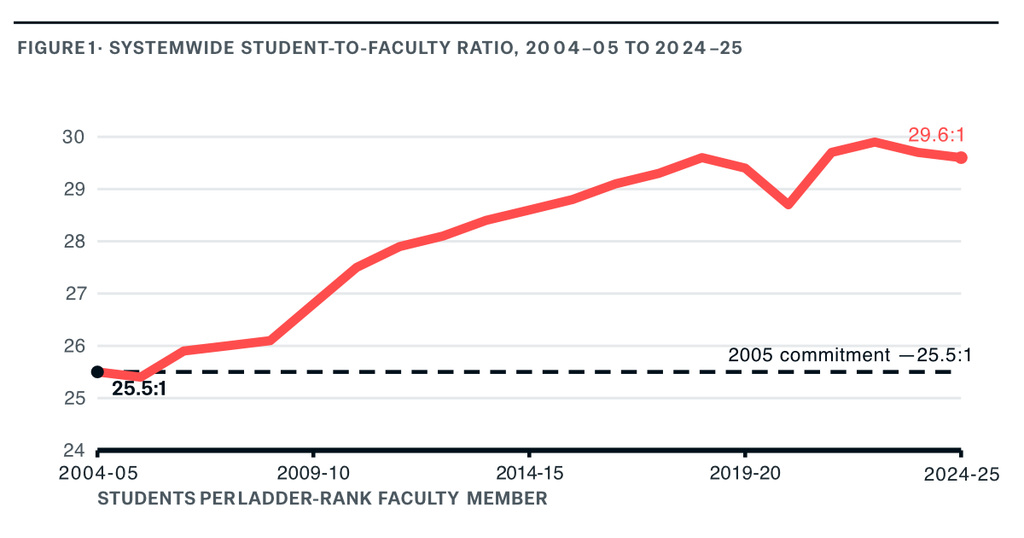
Worsening student-faculty ratios have had severe effects on the education and research mission of the university. Faculty report low morale, high workloads, and burnout. Faculty are teaching more students, often with less instructional support from teaching assistants; course quality is being sacrificed to make workloads manageable; and research time is being displaced by ever-expanding teaching, administrative, and service demands. These conditions are unsustainable for faculty and harmful to our students.
“The University must return to paying competitive salaries and paying faculty merits; the University will not permit the student-faculty ratio to deteriorate further ;… The University will not further risk the quality of the institution.” — University of California, Budget for Current Operations, 2004-2005, P. 10
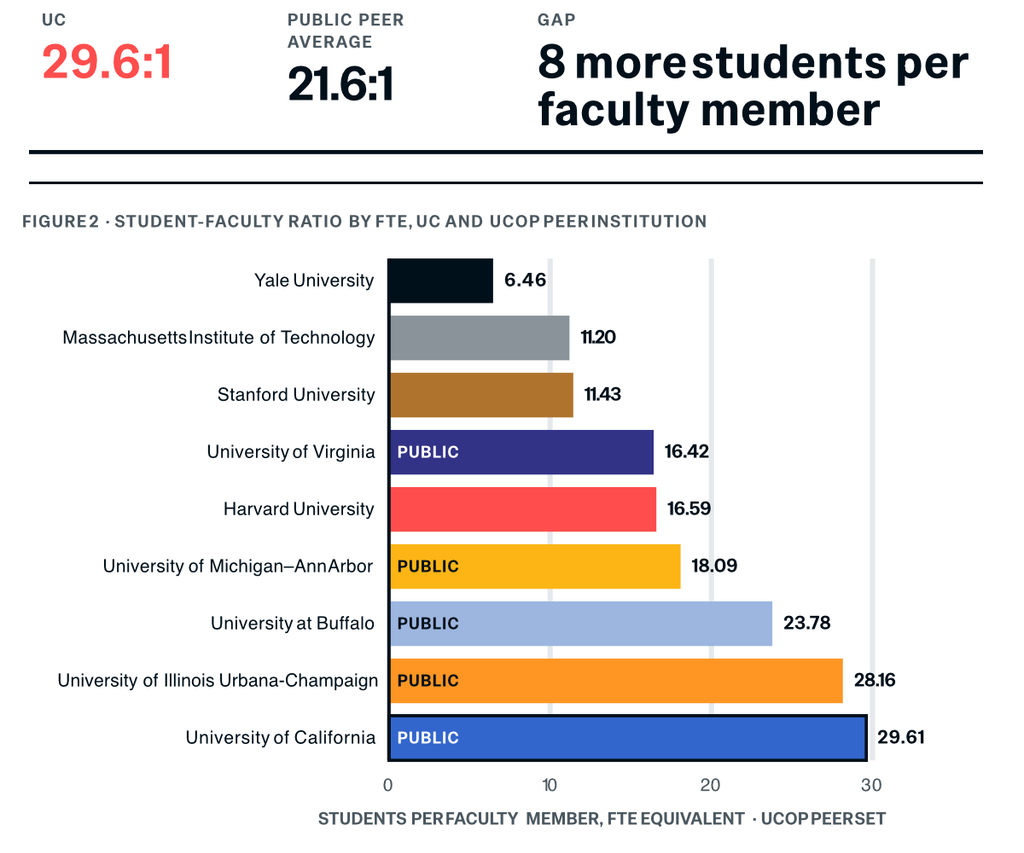
UC is an outlier among the institutions it calls its peers.
The current UC student-faculty ratio is higher than all of the eight public and private institutions that UCOP sets as its peers. Even just comparing the UC to the four public universities in this list, we find that they averaged 21.6 students per faculty member — a whole 8 students lower than the UC ratio.
Instead of investing in faculty, UC invested in management and administration.
Between 2005 and 2025, senior manager and upper-level administrator positions have more than doubled, growing by 107%.3 Meanwhile, ladder-rank faculty have only grown by 27% — against a 47% increase in combined undergraduate and graduate enrollments over the same period.
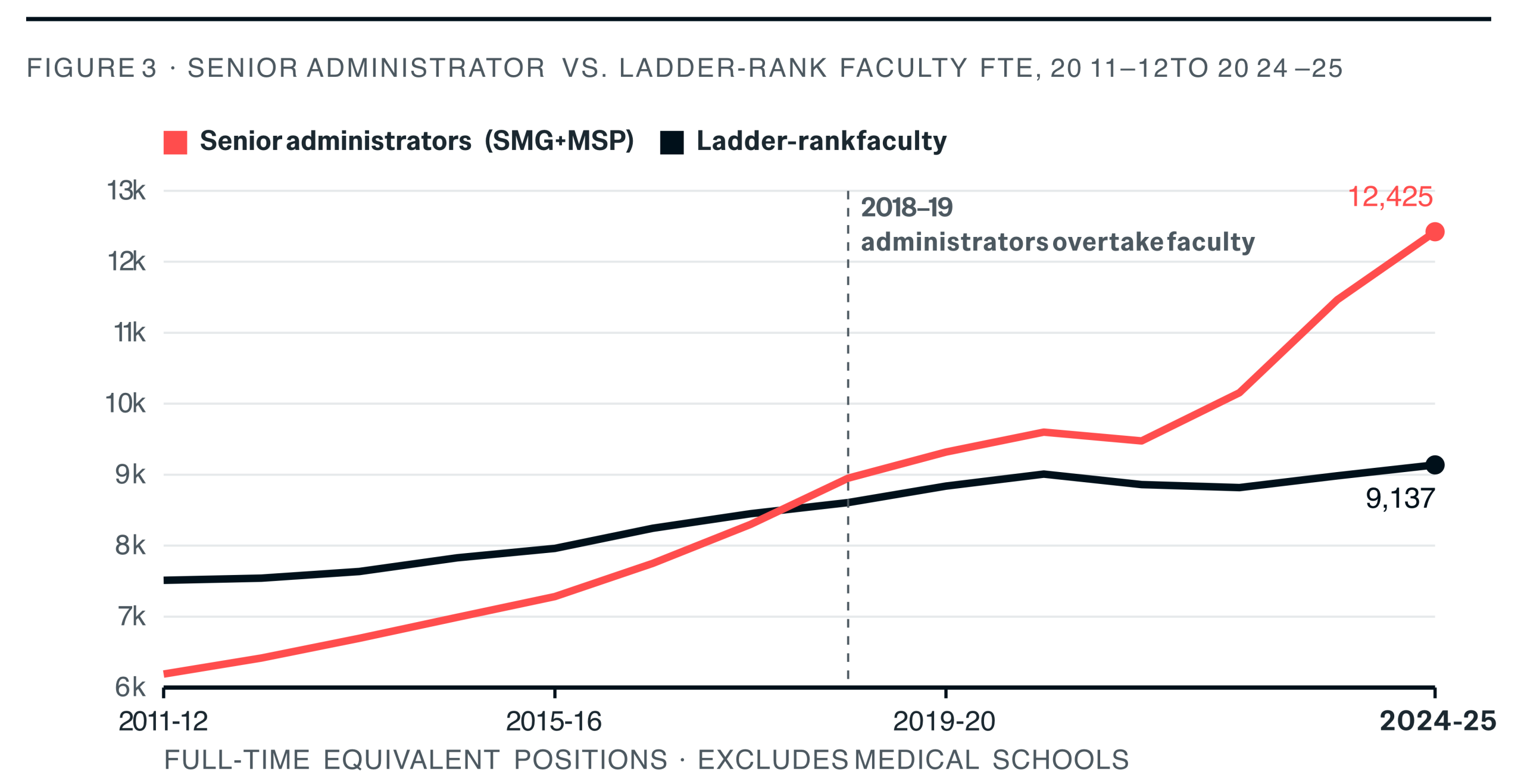
3,000+ positions
by which senior administrators now exceed ladder-rank faculty
It is revealing to consider changes in the raw total of these positions. In 2010, 6,190 staff were classified as either “Senior Management Group” or “Managers and Senior Professionals” — about 1,400 fewer than the ladder-rank faculty total. Today, the number of senior administrators exceeds the number of faculty by over 3,000 positions. If only one quarter of the additional 6,000 senior administrators hired over this period had been ladder-rank faculty, UC’s student-faculty ratio would be below our demand of 25.5 to 1.
Our Proposal: Involve faculty in a plan to return to the 25.5:1 ratio.
We advocate for shifting UC’s priorities back to its faculty-centered mission of education and research. While UC is a massive complex system, we believe that a clear plan to hire more faculty and to improve the student-faculty ratio is an urgent priority. Setting the goal of 25.5 to 1 is reasonable given UC’s 2005 commitment to not permit the student-faculty ratio to deteriorate further.
Enacting a more robust faculty hiring initiative within such a varied institution requires faculty participation. For that reason, we insist that faculty have a seat at the table to formulate the plan and see to its implementation.
We ask UCOP to enter into negotiations with faculty to create a dialogue that ends in a binding agreement. To ensure these proposals are implemented effectively and transparently, the Faculty Association will hold open elections for a faculty negotiating committee representing all campuses and academic areas.
A binding plan
With targets and a timeline to
reach 25.5:1 systemwide.
A seat at the table
An elected, representative faculty committee to negotiate with UCOP.
Real accountability
Faculty take part in
implementation and subsequent
oversight
This is what Organizing can win.
–REINVEST IN THE MISSION: SIGN THE PETITION–
Sources & Notes
- University of California, 2004–2005, Budget for Current Operations, p. 10.
- University of California, Information Center: Student-Faculty ratio. https://www.universityofcalifornia.edu/about-us/information-center/student-faculty-ratio;
faculty-ratio; We follow the National Center for Education Statistics (NCES) by calculating the student-faculty ratio in terms of ladder-rank faculty. NCES explains that student-instructor ratios are most reliable when based on the permanent and stable teaching workforce, and that this methodology best enables comparison across universities. - We define senior administrators by combining two of UCOP’s employee categories: “Senior Management Group” and “Managers and Senior Professionals.” This combined category includes senior administrators such as vice chancellors, campus counsels, and vice presidents, as well as senior managers such as assistant deans, associate and assistant vice chancellors and other administrators, and senior professionals such as senior administrative analysts, IT specialists, fundraisers, and coaches. Counts exclude medical school appointments, which generally do not involve undergraduate instruction.