How much will it cost us to restore public higher education?
This post has been superseded by updated versions:
How much will it cost us to restore public higher education in 2011-12?
How much will it cost us to restore public higher education in 2012-13?
How much will it cost us to restore public higher education in 2013-14?
Raising revenue has become such a taboo subject in California politics, nobody has gone to the trouble of actually answering that question — until now.
For the median California tax return (individual or joint), restoring the entire system while rolling back student fees to what they were a decade ago would cost less than $32 next April 15.
Surprised? So were we. Read “Financial Options for Restoring Quality and Access to Public Higher Education in California” below or download a PDF of it (March 2010, 9 pp.) If you’re really a policy wonk, download the spreadsheets behind this report.
540 Calculator: What restoring the system will cost you.
WORKING PAPER
FINANCIAL OPTIONS FOR RESTORING QUALITY AND ACCESS TO PUBLIC HIGHER EDUCATION IN CALIFORNIA
.
Stanton A. Glantz
Professor of Medicine
American Legacy Foundation Distinguished Professor in Tobacco Control
University of California San Francisco
Chair, University of California Systemwide Committee on Planning and Budget (2005-6)
Vice President, Council of UC Faculty Associations
glantz@medicine.ucsf.edu
Eric Hays
Director of Research, Council of UC Faculty Associations
info@cucfa.org
(Version 2 — March 18, 2010)
Council of UC Faculty Associations
15 Shattuck Square, #200
Berkeley, CA 94704
Phone: (800) 431-3348
.
EXECUTIVE SUMMARY
It is widely recognized that large reductions in state funding and sizeable increases in student fees have eroded quality and accessibility in California’s three-segment system of public higher education: the University of California, California State University and California Community Colleges. But, until now, no one has estimated what it would cost – through restored taxpayer funding or tuition increases — to restore the system’s historic quality while accommodating the thousands of qualified students excluded by recent budget cuts. This working paper considers state funding, student fees and accessibility to answer three basic questions about the public higher education system in California:
#1. How much would it cost taxpayers to push the “reset” button for public higher education, restoring access and quality (measured as per-student state support) while rolling back student fees to 2000-01 levels, adjusted for inflation?
Answer: It would cost taxpayers $4.643 billion.
#2. Absent restoration of taxpayer support for public higher education, how much more would student fees need to be increased to restore the level of per-student resources available in 2000-01 and accommodate all eligible students?
Answer: UC fees would have to increase above currently approved levels by $5,514 (to a total of $17,064), CSU fees by $2,075 (to $6,968) and CCC fees by $484 (to $1,264).
#3. If the Governor and Legislature were to decide to push the “reset” button, — reinstating the quality and accessibility standards of the Master Plan by returning state support and student fees to 2000-01 levels, adjusted for inflation — what would it cost the typical California taxpayer?
Answer: It would cost the median California taxpayer less than $32.
Introduction
It is widely recognized that beginning with Governor Gray Davis’ 2001-2 budget year and accelerating with Governor Arnold Schwarzenegger’s Compact for Higher Education,[1] higher education in California has suffered large reductions in state funding. These reductions have effectively abandoned the California Master Plan for Higher Education[2] promise of high quality, low cost public higher education for all, through an articulated system consisting of the University of California, California State University and California Community Colleges. Funding has fallen more quickly in California than in the United States as a whole (Figure 1a).
At the same time, fees in all three sectors have increased much faster in California than in the US as a whole (Figure 1b). While these fee increases have generally been framed as responses to the State’s immediate budgetary problems, they are also congruent with an explicit public policy choice, purportedly based on free market principles, to shift higher education from a public good provided by society as a whole through taxation to being a private good purchased through user fees.
.
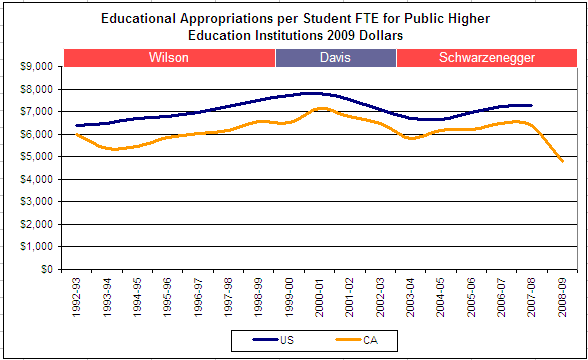
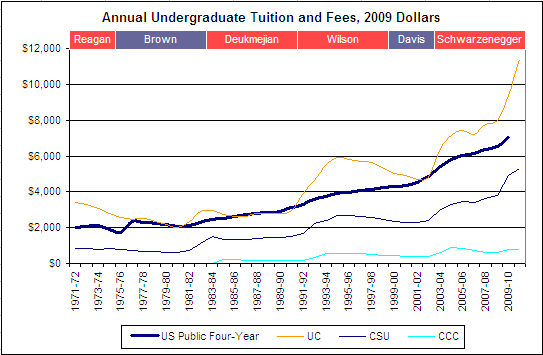
Figure 1. State funding and fees per student in California compared to the rest of the United States. State support of higher education in California has been below the national average. Support has fallen more rapidly and fees have increased more quickly than in the rest of the United States. California is not simply following national trends. (Sources: State Higher Education Executive Officers http://www.sheeo.org/finance/shef-home.htm, California Legislative Analyst’s Office http://lao.ca.gov/sections/econ_fiscal/Historical_Expenditures_Pivot.xls, College Board http://www.trends-collegeboard.com/college_pricing/, and California Post Secondary Education Commission http://www.cpec.ca.gov/OnLineData/SelectFirstOptions.ASP?ReportType=Enroll.)
.
This shift in public policy is stated in the 2004 Compact on Higher Education between Governor Schwarzenegger and the UC President and CSU Chancellor: “In order to help maintain quality and enhance academic and research programs, UC will continue to seek additional private resources and maximize other fund sources available to the University to support basic programs. CSU will do the same in order to enhance the quality of its academic programs.” Until this point, the state was viewed as the primary source of support for “basic programs” with private sources being used for additional initiatives.
This working paper seeks to tie together the three elements of change: drops in state funding, fee increases, and declines in quality (measured as per student expenditures). It takes as its base year 2000-01, the last year that higher education was reasonably financially intact before the recent large fee increases. This paper addresses three questions:
- How much would it cost taxpayers to push the “reset” button for public higher education, restoring access and quality (measured as per-student state support) while rolling back student fees to 2000-01 levels, adjusted for inflation?
- Absent restoration of taxpayer support for public higher education, how much more would student fees need to be increased to restore the level of per-student resources available in 2000-01, and accommodate all eligible students?
- If the Governor and Legislature were to decide to push the “reset” button, — reinstating the quality and accessibility standards of the Master Plan by returning state support and student fees to 2000-01 levels, adjusted for inflation — what would it cost the typical California taxpayer?
Answer No. 1: Returning quality and fees to the level of 2000-01 would cost taxpayers $4.643 billion.
By restoring state funding to 2000-01 levels, it would be possible to return student fees to the levels of 2000-01 (adjusted for inflation) while maintaining quality (measured as total per student funding). Specifically, annual fees at UC would be rolled back to $4,924 (from $11,550), for CSU to $2,284 (from $4,893) and CCC to $410 (from $780).
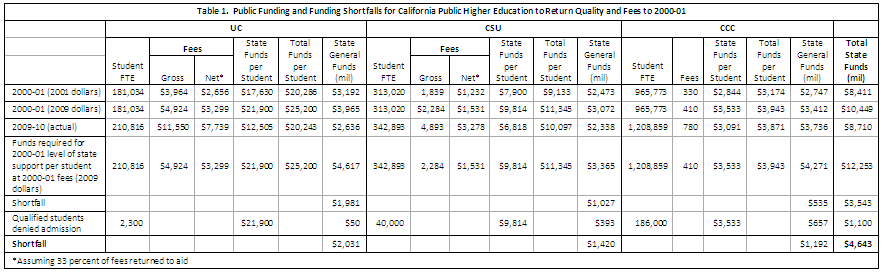
Table 1 shows the calculations that produced this number.[3] We begin with the numbers of full time equivalent (FTE) students in each of the three sectors of California higher education and total state general funds supplied to each sector,[4] then divide one by the other to obtain the state funding per student FTE. Next we adjust the 2000-01 dollar amounts for inflation to their equivalents for 2009-10 and subtract the actual levels of funding per student currently enrolled in each sector to determine the funding shortfall compared to 2000-01.
Restoring full state funding for existing enrollments would cost a total of $3.543 billion.
These calculations do not tell the whole story, however, because all three sectors have responded to resource cuts by admitting fewer students than they would under the Master Plan. UC has reduced enrollment by 2,300 students,[5] CSU has reduced enrollment by 40,000 students;[6] and the CCCs have reduced enrollment by 186,000 FTE students.[7] We assume that providing funding for these students, in addition to current enrollments, would restore full access to each segment of California’s public higher education system. The cost to support full enrollment at 2000-01 levels of state per-student support would be $4.643 billion.
Student fees would return to their 2000-01 levels, adjusted for inflation: $4,924 for UC, $2,284 for CSU and $410 for CCC.
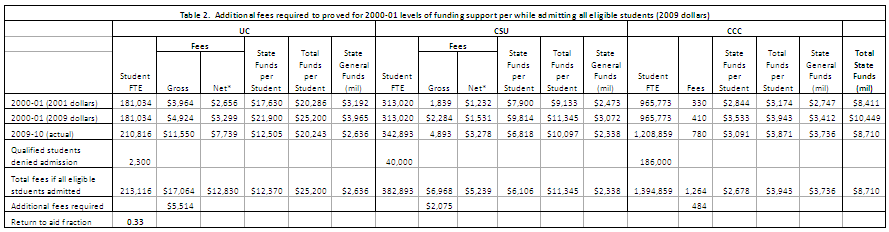
Answer No. 2: Restoring the public higher education system for all students who meet the standards outlined in the Master Plan only by increasing student fees would require raising UC fees an additional $5,514 (to a total of $17,064), CSU fees by $2,075 (to $6,968) and CCC fees by $484 (to $1,264).
Table 2 outlines the calculations that led to these numbers.[8] The overall approach is the same as in Table 1, except that rather than restoring per student total expenditures by increasing state support, it is done by increasing student fees. Calculations for UC and CSU assume that it continues its “high fee high aid” policy of allocating 33 percent of fees to student aid.[9] The total funding per student used as a measure of quality is the sum of state funding and net tuition and fees after deleting the fee amounts returned to aid.
These calculations assume no further cuts in state support for higher education. For each additional 10 percent cut in state support, tuition and fees at UC would have to be increased by $1,645, CSU by $812 and CCC by $268 in order to maintain quality at current enrollment levels.
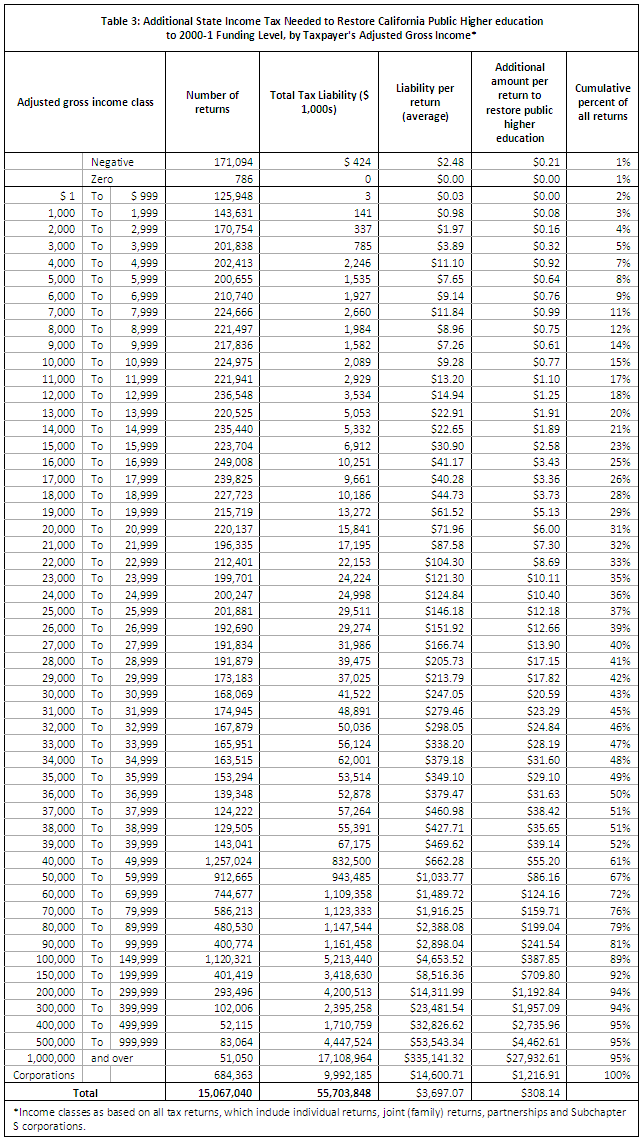
Answer No.3: Restoring public higher education while returning student fees to 2000-01 levels would cost the median California taxpayer an additional $32.
Table 3 outlines these calculations. We obtained the distribution of taxes paid by adjusted gross income from the Franchise Tax Board for 2006,[10] the most recent year available, then allocated the $4.643 billion it would cost to restore public higher education to 2000-01 proportionately to the amount that each taxpayer now pays across all taxpayers. Note that the categories are for tax returns, not individuals, so the results are for joint returns (families), individual returns, partnerships and Subchapter S corporations, as well as corporations that pay income taxes.
For the median personal income taxpayer, restoring the entire system while rolling back student fees to what they were a decade ago would cost less than $32 next April 15.[11] For the two-thirds of state taxpayers with taxable incomes below $60,000, it would cost $86 or less. For the 12 million state taxpayers with AGI below $100,000 (81 percent), it would be $242 or less.
Income taxes are presented as one option, simply to illustrate the cost for typical taxpayers. Personal and corporate income taxes are only 65 percent[12] of all state revenues; part of the $4.643 billion could be allocated to other taxes, which would lower the effect on individual income tax payers. We also assume that the costs would be distributed uniformly across all tax categories. If the cost were allocated more or less progressively, that would also affect impact on individual taxpayers.
Limitations
The calculations outlined in this working paper are all based on publicly available numbers and do not benefit from models of enrollment dynamics that may be maintained by state agencies or the three segments of the California public higher education system. We assume that there would be no change in enrollment between Fall 2009 and Fall 2010 under our base case. The estimates do not account for price elasticity: as tuition and fees increase, some students decide not to attend public higher education in California, which will reduce student demand.
We assume, based on public statements and documents, that increasing UC enrollment by 2,300, CSU by 40,000 and CCCs by 186,000 would allow every interested student to attend an appropriate institution of public higher education in California. As a result, the $4.643 billion estimated total cost (and the corresponding $32 median tax increase) may be an upper bound estimate of the actual cost. At the same time, the $3.543 billion shortfall based on current enrollments (Table 1), which corresponds to a median tax increase of $24, probably underestimates the cost. The true cost — and impact on taxpayers — is likely to be between these two estimates: $24-32.
Finally, the distribution of taxes is based on 2006, the most recent time for which data are available; this distribution will be slightly different in 2010.
These calculations will be updated and subsequent versions of this Working Paper will be released as better data become available.
FOOTNOTES:
[1] The full text of the Compact is at http://budget.ucop.edu/2005-11compactagreement.pdf.
[2] The full text of the Master Plan is at http://www.ucop.edu/acadinit/mastplan/MasterPlan1960.pdf. For a discussion of the history and current status of the Master Plan, see Legislative Analyst Office, “The Master Plan at 50: Assessing California’s Vision for Higher Education,” November, 2009, available at http://www.lao.ca.gov/laoapp/PubDetails.aspx?id=2141.
[3] The spreadsheet used to obtain all the results in this working paper is available.
[4] FTE data comes from the California Postsecondary Education Commission available at http://www.cpec.ca.gov/OnLineData/SelectFirstOptions.ASP?ReportType=Enroll, state expenditure data comes from the Legislative Analyst’s Office available at http://lao.ca.gov/sections/econ_fiscal/Historical_Expenditures_Pivot.xls.
[5] UC cut enrollment 2,300 in 2009-10 and plans to cut enrollment a further 2,300 in 2010-11, see: http://www.universityofcalifornia.edu/regents/regmeet/nov09/f3.pdf)
[6] According to http://www.calstate.edu/PA/News/2009/enrollment-budget.shtml CSU is curtailing enrollments by “more than 40,000 students.”
[7] According to http://www.cpec.ca.gov/Agendas/Agenda0909/Item_07.pdf CCC enrollment has been reduced by 186,000 FTE students. The estimated increases in state funding or fees that are computed based on this estimate are higher than would be necessary to the extent that some of these students are the 2,300 denied admission at UC or the 40,000 denied admission at CSU. Restoring access to UC and CSU would reduce the demands placed on CCC.
[8] Table 2 of the December, 2009, version of this report calculated the fees required to restore higher education quality, but did not include the costs to accommodate eligible students who are currently being denied admission. This version of the report updates Table 2 and the relevant discussion to calculate the fees required to restore quality and enrollment.
[9] See page 16 of http://www.assembly.ca.gov/acs/committee/c2/hearing/2005/april%2020%20%202005-uc%20csu-%20public-%20cm.doc.
[10] State income tax revenue by adjusted gross income class: http://www.ftb.ca.gov/aboutftb/Tax_Statistics/AGIC.shtml and state income tax revenue from corporations: http://www.ftb.ca.gov/aboutftb/Tax_Statistics/Corporations.shtml.
[11] For comparison, in 2007 the statewide median income for all personal income tax returns rose to $35,646, while the median income listed on joint returns was $68,797. Source: Franchise Tax Board, available at http://www.ftb.ca.gov/aboutftb/press/2009/release_25.shtml.
[12] Governor’s Budget Revenue Estimates: http://www.ebudget.ca.gov/pdf/BudgetSummary/RevenueEstimates.pdf.
Surprised? So were we. Read “Financial Options for Restoring Quality and Access to Public Higher Education in California” below or download PDF